Your first year as an intervention specialist can feel like you’re drowning in IEPs, data, and chaos. But take a deep breath. You’re not alone. Here are six practical tips to help you navigate the whirlwind and stay grounded.
Starting Out as a New Intervention Specialist? Read This First.
So, it’s your first year as an intervention specialist? Your to-do list may be beginning to sound scary: IEPs to write, data to collect, meetings popping up left and right, and…oh yeah…somehow finding time to actually deliver interventions.
I remember my first year like it was yesterday. I felt completely underwater. Between trying to “prove myself” and pretending I had it all figured out, I missed opportunities to learn and connect. Looking back, there are a handful of things I wish someone had whispered in my ear that first chaotic week of school. So now? I’m here to share some with you.
1. Get to Know Your Students
The next piece of advice is get to know your students. Yeah, yeah, I know “build relationships” is the big buzzword fix all right now. But for us intervention specialists, it’s foundational.
Here’s the deal: special education carries a stigma, especially with older students. They’re aware of who gets pulled out. They know when they’re getting different instructions. That’s why it’s crucial to create a space that feels safe, judgment-free, and supportive from day one.
Here’s how to get started:
- Ask about their interests: video games, pets, favorite snacks, music, learn their lingo.
- Take notes on what strategies help them feel successful.
- Pull students during quiet times (like study hall or before school) for a quick “get to know you” chat.
- If you’re co-teaching or doing inclusion, don’t just connect with your caseload. Connect with all the students.
When students feel seen and valued, they’re more willing to take risks, try strategies, and advocate for themselves. That’s the real magic of special education.
2. Learn Their IEPs Early (Like… Yesterday)
Reading a document about a student you don’t know yet can get really confusing. But the sooner you dig into your students’ plans, the smoother your year will go.
Start by grabbing all the IEPs for your caseload. Don’t wait for someone to hand them to you. Then, break them down into bite-sized info.
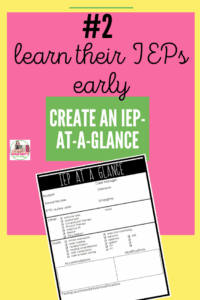
Quick tip? Create an “IEP at a Glance” sheet.
This handy little tool should include:
- Key accommodations
- Service minutes
- Goals
- Behavior plans (if applicable)
- Testing accommodations
You can hand these out to gen ed teachers too.They’ll appreciate having the essentials at their fingertips without needing to read 20+ pages.
P.S. Many IEP writing platforms can generate these for you automatically. Don’t be afraid to ask for help finding it.
I have also created a completely editable IEP at a Glance form click the picture to see in the shop.
3. Be Visible You’re a Key Team Member
I used to think I needed to blend into the background until I “knew what I was doing.” Huge mistake. Special education isn’t a solo mission. It’s a team sport.
Start by introducing yourself to the general education teachers. Bring along those IEP-at-a-glance sheets. It opens the door for conversation and shows you’re there to collaborate, not micromanage.
Staying connected helps in so many ways:
- You can align your interventions with what’s happening in the classroom.
- You’ll gather better data by seeing how students apply skills in context.
- You’ll gain respect and support from your colleagues.
You’re not “just” the special ed teacher. You’re a critical part of every student’s success team. Own that role.
But here’s an underrated pro-tip: make friends with the office staff.
The secretaries, administrative assistants, and office managers? They’re often the glue that holds the school together. They can help you:
- Schedule and organize IEP or ETR meetings
- Track down hard-to-reach staff
- Navigate school procedures you didn’t even know existed
- And honestly, save your sanity when chaos strikes
They’re information hubs, problem-solvers, and usually know the pulse of everything happening in the building. A little kindness and simply asking how their day’s going? It goes a long way.
4. Don’t Be Afraid to Ask for Help
This one’s personal. I spent so much time trying to not look lost that I made things way harder than they needed to be. Asking for help doesn’t make you look clueless. It makes you look smart and collaborative.
 Ask for:
- Feedback on your IEP drafts
- Support with data collection tools
- Clarification on procedures or timelines
- A seat at the table during veteran-led IEP meetings
You’ll learn faster, avoid rookie mistakes, and build relationships that’ll support you all year long.
Veteran teachers? They get it. Most of them want to help, they’ve been there too. Let them.
5. Plan Your Year: Yes, the Whole Thing
Nothing like an IEP deadline popping up mid-September to throw your life into chaos. If you only take one tip from this post, let it be this one.
Map out your entire year now.
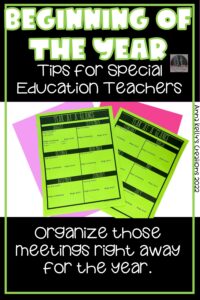
- Use a spreadsheet or planner to log all IEP due dates
- Highlight ETRs, reevals, and progress reports.
- Set reminders 2 months out to start each draft
- Schedule send-home dates for parent review
Plug all of that into your Google Calendar, physical planner, or whatever system works for you.
You will feel so prepared! It’s the one thing we can organize and check off our list at the beginning of the year. The more you anticipate, the less reactive you’ll need to be.
6. Protect Your Peace
This job can feel like it never ends. During those first few weeks, you might wonder how the heck anyone survives in this role long-term. It does get better.
Here’s what you need to remember:
- It’s okay to not have everything figured out.
- You’re allowed to make mistakes.
- You must take care of yourself.
Set boundaries early:
- Turn off school email alerts on nights and weekends.
- Carve out a hard stop time for your workday.
- Give yourself permission to not grade or plan on Sundays.
Repeat after me: You are not your job.
You’re a human first, and your wellness matters. Your students and family need the best version of you. That includes the rested, not-burned-out version.
You’re Doing Better Than You Think
If you’re here reading this? You’re already showing up for your students. That’s half the battle. You care, and that matters more than perfection ever will.
You’ve got this. And when it feels like you don’t? Come back to this post. Or reach out to a teammate. You’re growing. You’re becoming the intervention specialist your students need.
Want some shortcuts to stay organized?
Check out my IEP organization resources here they’re filled with ready-to-use forms that saved my sanity during those first few years.
If you’ve got questions, ideas, or just need someone to tell you you’re doing great? Drop a comment. I’m cheering you on.
FAQs
What is the role of an intervention specialist?
An intervention specialist supports students with disabilities through individualized instruction, IEP implementation, data tracking, and collaboration with staff and families.
How do I stay organized with multiple IEP deadlines?
Use a spreadsheet, calendar, or digital planner to track due dates, start drafts early, and set reminders well in advance.
How do I build rapport with general education teachers?
Introduce yourself early, offer IEP-at-a-glance tools, offer help with explanations of SPED terms or resources, and stay involved with classroom activities to show you’re a team player.
Final Words
Remember: this year doesn’t have to be perfect to be powerful. You’re going to learn a ton. You’ll mess up a little. You’ll grow a lot. And most importantly, you’ll make a real difference in your students’ lives.
You’re doing better than you think. Keep going. 💛